
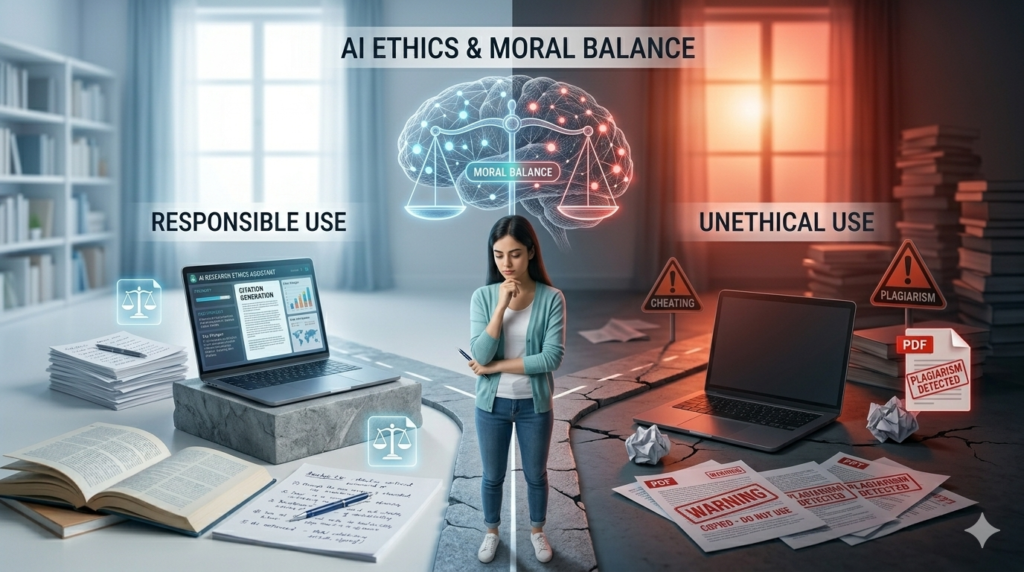
AI tools are transforming what’s possible for students. But they’ve also created a new and rapidly evolving set of ethical questions that every student must understand – and that universities are actively responding to with new policies, detection tools, and academic integrity frameworks.
This is not a lecture. It’s the honest, practical truth about AI ethics in academia – the rules, the consequences, and how to protect your academic career while still enjoying everything AI has to offer.
of universities now have specific AI use policies - and 73% updated them in the last 12 month
of university AI policies - your institution may fall into any of these categories
the maximum penalty at most universities for submitting AI-written work as your own
is all it takes to check your university's AI policy and protect your academic future
01. The Clear Line Between Using AI and Cheating with AI
Most students aren’t trying to cheat. They’re confused about where the line is. Here is the clearest possible breakdown:
Ethical AI Use — Almost Universally Accepted
- Using AI to explain a concept you don't understand
- Using Grammarly to fix grammar in your own writing
- Using AI to brainstorm topic ideas
- Using AI to get feedback on your draft's clarity
- Using AI to generate practice exam questions
- Using Zotero to format citations automatically
- Using AI research tools to find academic sources
- Using Otter.ai to transcribe your own lectures
Academic Dishonesty - Serious Consequences️
- Submitting AI-written text as your own work
- Using AI to write sections of your essay
- Copying AI responses into take-home exams
- Using AI during closed-book assessments
- Failing to disclose AI use when required
- Using AI to complete assignments for others
- Buying AI-generated essays from services
- Using AI to fabricate research data or citations
The dangerous zone is in the middle - using AI heavily for ideas and structure, then lightly editing the output. Even if this isn't technically plagiarism, it defeats the purpose of education (building your own thinking), risks policy violations, and often produces writing that doesn't actually sound like you - which professors and AI detectors both notice.
02. The 4 Types of University AI Policies
There is no single global policy on AI. Your university may fall into any of these four categories – and individual professors may have different rules than the general policy.
AI detection tools are not 100% accurate. They sometimes flag genuinely human-written text as AI-generated - particularly if you write in a clear, structured, confident style. This is why maintaining your authentic writing voice and keeping drafts of your work is important. If your genuine work is ever flagged, you need to be able to demonstrate your writing process.
04. Real Consequences of AI Misuse
These are not hypothetical. These are the actual consequences students face when caught submitting AI-generated work without permission:
Academic Consequences (Tiered by Severity)
- First offence, minor case: Zero on the assignment, written warning on file
- First offence, serious case: Fail the entire course, academic review meeting
- Repeated offences: Academic probation, suspension
- Severe cases: Expulsion from the university
- Post-graduation discovery: Degree revocation – this has happened
Professional Consequences
- In licensed professions (law, medicine, engineering, teaching) – degree revocation can mean career disqualification
- Academic integrity violations can be disclosed to professional licensing bodies
- Reputation damage in professional networks, especially in small fields
- Loss of scholarships or graduate school opportunities
05. How to Disclose AI Use Properly
If your university requires disclosure – or you simply want to demonstrate transparency – here is a clear template you can adapt for any submission:
06. The Deeper Reason to Use AI Ethically – Your Own Future
Beyond avoiding punishment, there is a deeper and more personally important reason to use AI ethically: your own long-term capability and success.
When you struggle with a concept and work through it, you build neural pathways that make you genuinely capable. When you use AI to skip that struggle, you miss the actual skill-building that education is designed to produce. In your career, employers will expect you to think, write, analyze, and solve problems independently. AI should accelerate your learning - not replace it. The students who use AI to learn faster will outperform both those who avoid AI and those who use it as a crutch.
07. 6 Golden Rules for Ethical AI Use in Academia
Academic AI Ethics Checklist
Checked my university's AI policy for this semester
Read the brief for each assignment to understand AI rules for that task specifically
All submitted writing is my own original thinking and analysis
Included AI disclosure statement where required
Kept drafts and notes to document my writing process
I can explain and defend every idea in my submission from my own understanding
Frequently Asked Questions
What happens if AI detection wrongly flags my genuine work?
This does happen, particularly with students who write in a very clear, structured way. If your work is flagged, you have the right to appeal. Your best defence is demonstrating your writing process: show draft versions, your research notes, your outline, and your editing history. This is why keeping your work-in-progress files is always a good habit.
Is using QuillBot to paraphrase my work academic dishonesty?
It depends on your institution's policy. QuillBot is a paraphrasing tool — it rewrites text you provide. If you're paraphrasing your own original writing to improve clarity, most institutions consider this acceptable (similar to using a thesaurus). If you're using it to paraphrase sources without proper citation, that is plagiarism. If you're using it to disguise AI-generated text, that violates AI policies. Check your specific institution's stance.
Can I cite ChatGPT as a source in my essay?
Generally, AI outputs are not considered credible academic sources and should not be cited as evidence in academic work. APA 7th edition does have a citation format for AI tools, but using AI as a primary source is rarely appropriate in academic writing. If you used ChatGPT to understand a concept, find the original peer-reviewed source that ChatGPT referenced and cite that instead.
Final Part of the AI for Students Series
Next: The future of AI in education - what's coming for students in the next 3 years, and how to position yourself to benefit from every development.