
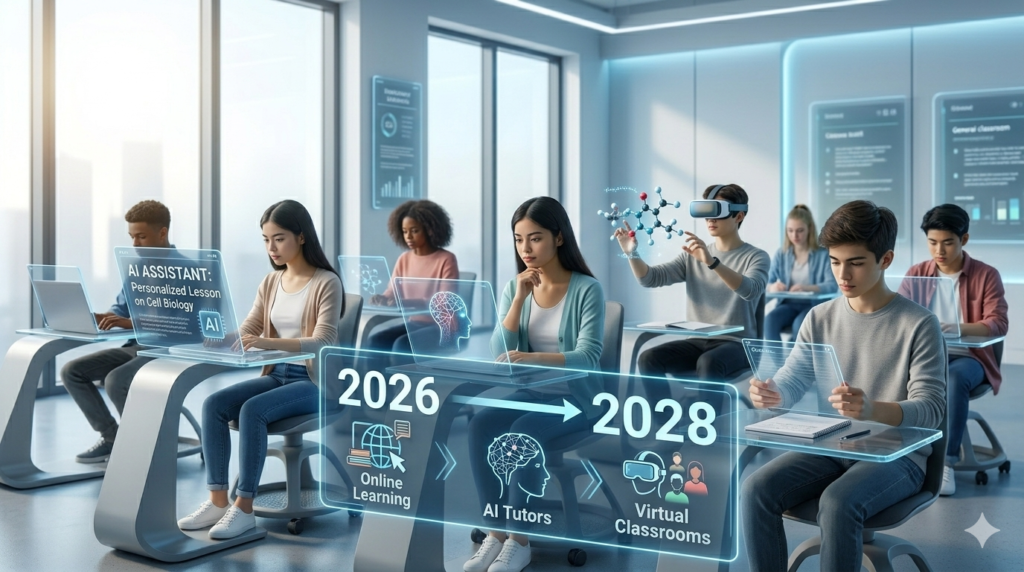
The future of AI in education is not a distant concept – it is arriving right now, faster than most students, educators, and universities realize. In 2026, the gap between students who understand AI and those who don’t is already measurable in academic performance, career preparedness, and professional opportunities.
Over the next 2-3 years, that gap will widen significantly. This post covers the 7 biggest AI trends that will reshape student life by 2028 – and exactly what you can do today to ensure you’re ahead of every one of them.
new jobs will emerge by 2027 that require AI skills - WEF Future of Jobs Report
cost to start building every AI skill on this list - all tools mentioned have free tiers
of primary school children today will work in jobs that don't yet exist - Dell Technologies
the best time to start building AI competency - before it becomes a minimum requirement
The Future of AI in Education: 7 Trends to Watch
The Future of AI in Education: Personalized AI Tutors Will Replace Generic Online Courses
Today’s AI tutors (ChatGPT, Claude, and Khan Academy’s Khanmigo) can already adapt explanations to your level. By 2027, fully personalized AI tutors will know your learning history, your weak areas, your preferred explanation style, and your exam schedule – and will create a completely individualized learning curriculum in real time.
These systems will know that you understand photosynthesis at a surface level but struggle with the light-dependent reactions and will build you a tailored 2-week curriculum that specifically addresses your gap – automatically, without you having to diagnose the problem yourself.
When to expect this: Early versions available now (Khanmigo, Synthesis AI). Fully personalized AI tutors at university level are expected to be mainstream by 2027.
Use ChatGPT now to ask for personalized explanations: "I understand X but struggle with Y. Teach me Y in a way that connects it to what I already know." You're already learning how to work with personalized AI - the tools will just get better at doing it automatically.
AI Will Be a Required Skill in Every Graduate-Level Job
By 2028, AI literacy will be a baseline requirement – not a bonus – in the vast majority of graduate-level job descriptions. The World Economic Forum already lists “AI and big data” as the fastest-growing skill cluster of 2026–2028 across almost every industry.
This doesn’t mean you need to be a programmer or data scientist. It means employers will expect you to know how to use AI tools relevant to your field, how to evaluate AI outputs critically, how to prompt AI effectively for professional tasks, and how to integrate AI into collaborative workflows.
When to expect this: Already happening in tech, finance, law, and consulting. Expanding to healthcare, education, and public service by 2027.
Build a "AI Skills" section in your CV now. List every AI tool you use and how you use it professionally. ChatGPT for research and writing, Grammarly for professional communications, Notion AI for project management. Employers are already looking for this.
University Assessments Will Transform to Verify Human Thinking
Universities are rapidly adapting to AI. The era of take-home essays as the primary assessment method is ending. By 2027, most universities will have shifted heavily toward in-person assessments, oral exams, portfolio work, and process-based evaluation – all of which verify that genuine learning has occurred.
This is actually good news for students who study properly. AI-proof assessments test exactly the skills that matter in careers: your ability to think on your feet, explain concepts verbally, apply knowledge to novel problems, and demonstrate genuine understanding under pressure.
When to expect this: Already accelerating at leading universities in 2026. Expected to be the norm across most institutions by 2027-2028.
Use AI to deepen your understanding - not to bypass it. Practice explaining concepts out loud using AI as a testing partner: "Ask me questions about [topic] and tell me when my explanation is incomplete." You're preparing for the oral-exam era now.
AI-Powered Career Guidance Will Replace Generic Counseling
Career counseling at universities has always suffered from a fundamental limitation: counselors who know your interests but can’t deeply know every industry, role, and hiring trend simultaneously. AI career advisors will change this entirely by 2027.
Future AI career tools will analyze your academic record, interests, skills, and market trends simultaneously – and recommend specific career paths, skills gaps to fill, internship opportunities, and even which professors to connect with. They’ll tell you not just what to pursue, but exactly how to get there from where you are now.
When to expect this: Early AI career tools (Jobscan, LinkedIn AI features, Handshake AI) are available now. Comprehensive AI career advisors for students expected at mainstream adoption by 2027.
Use ChatGPT now for career exploration: "I'm studying [subject] and interested in [interests]. What are 10 career paths I might not have considered? For each one, tell me what additional skills I'd need and how competitive it is in 2026."
Real-Time AI Translation Will Eliminate Language Barriers in Education
For the hundreds of millions of students studying in a non-native language, AI translation and language assistance already provides significant support. By 2027, real-time AI translation in lectures, textbooks, and academic papers will be seamlessly integrated into standard university infrastructure.
International students will be able to hear lectures in their native language simultaneously, have textbooks automatically translated at publication quality, and submit work that is evaluated on ideas rather than penalized for imperfect grammar in a second language.
When to expect this: DeepL, Google Translate AI, and Microsoft Translator are already excellent. Real-time lecture translation integrated into university systems is expected to be standard by 2027.
International students: use DeepL (the most accurate AI translator available) for academic reading. Use LanguageTool or Grammarly for writing assistance. These tools are excellent right now and will only improve.
AI Will Democratize Access to World-Class Education
One of the most profound changes AI is bringing to education is the democratization of access. A student in a rural area with limited school resources, or in a developing country with few local universities, will have access to the same quality of explanations, tutoring, and academic support as a student at an elite institution – through AI.
Khan Academy AI, ChatGPT, Claude, and similar tools already provide expert-level tutoring at zero cost. By 2028, AI will further close the educational gap that has always existed between students from wealthy and under-resourced backgrounds.
When to expect this: This is already happening. Khan Academy Khanmigo, ChatGPT, Elicit, and Notion AI are available globally for free or minimal cost. The infrastructure continues to improve.
If you have access to AI tools, you have access to world-class educational support. Use it fully. The playing field has never been more level - take advantage of it.
AI Agents Will Manage Student Administrative Life Automatically
Today, students spend enormous amounts of time on administration: scheduling, deadline management, form submission, course selection, application processes. By 2027, AI agents – autonomous AI systems that can take multi-step actions on your behalf – will handle most of this automatically.
Your AI agent will monitor your email for important university communications, remind you of deadlines before you miss them, automatically draft responses to administrative emails, suggest course combinations based on your degree requirements and career goals, and even help manage scholarship applications. All running quietly in the background while you focus on studying.
When to expect this: Early agentic features are already in Notion AI and Google Workspace. Student-specific AI agents are expected to be widely available by 2027.
Start using Notion AI to organize your academic life in one place. The habit of centralizing your information - assignments, deadlines, notes - is exactly the foundation that agentic AI systems will build on. Every workflow you create today becomes a template for tomorrow's automation.
2026
2026–27
2027
2027-28
2028+
The future of AI in education is moving faster than most students realize – start building these skills today.
Frequently Asked Questions
Will AI make university degrees pointless?
No. University degrees develop critical thinking, domain expertise, professional networks, and verified credentials - all things AI cannot provide. What will change is that the evidence of learning will increasingly shift from written take-home work (which AI can do) to demonstrated understanding (which AI cannot fake for you). The value of genuine learning is increasing, not decreasing
What subjects will be most and least affected by AI?
Most affected (in terms of how skills are practiced and assessed): writing-heavy humanities subjects, law, and business. Least affected in terms of core skill demand: STEM subjects where mathematical reasoning, experimental skills, and engineering judgment remain fundamentally human. However, every field will be affected in terms of how AI tools are used as professional instruments - including medicine, engineering, and scientific research.
How do I stay up to date with new AI tools for students?
Follow AI-focused educational newsletters and subreddits (r/ChatGPT, r/learnmachinelearning). Subscribe to updates from tools you already use. Check Product Hunt monthly for new AI tool launches. Set a Google Alert for "AI tools for students." Most importantly - try new tools when you hear about them. A 30-minute trial tells you more than any review.
←Go Back to the Begining
Share this series with a classmate who could benefit - and start applying these tools today.